Skip to content

Vending machine business game

Run a vending machine business for a few weeks: place the machines, stock the slots, drive the restock trips and see what is left.

A free vending machine business online: 7 levels that start easy, a daily and an endless one. It runs in your browser, on a phone too.

Try one decision

Your first snack machine needs a home. This week, where does it go?

Start the route: level 1

About 4 minutes, $150 in the cash box to start. No sign-up.

The levels

7 levels. Each adds one money idea and keeps the old ones. Start anywhere; the marked one is next for you.

What you will do

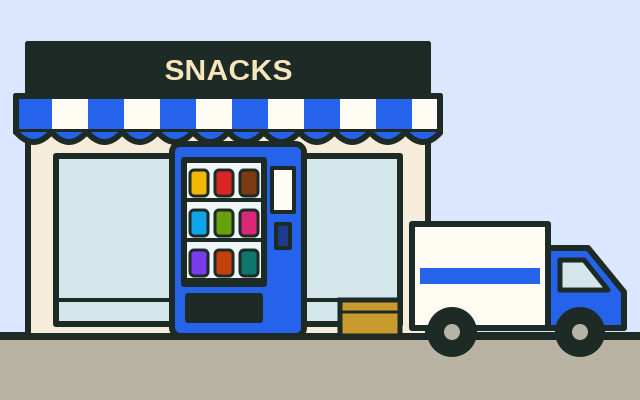
A snack machine in a shop window under a blue awning, and a van at the curb
  • Pick the places

    An office, a gym, a warehouse: each has its crowd, its hours and the share of sales its manager asks.

  • Stock and price

    Choose what goes in six slots. You keep the price minus what the item cost you.

  • Drive the route

    Send the van before the favorites run out. Every trip costs gas and an hour of yours.

  • Read the books

    Commission, card fees, gas, a loan and a machine that wears out: every line happened in front of you.

Vending Machine Route calculators and drills

Tools for the numbers of this business: yours, or the game's.

Money skills in this game

The ideas this business's books are built on, one page each.

Where the money comes from

A vending machine business earns one item at a time. What it keeps on an item is the price minus what the item cost, and a machine earns that times how many it sells. A favorite with a small margin can earn more than a rich item nobody buys.

The place the machine stands in may want a share of the sales, called a commission, or a flat rent, or nothing. A busy place that takes a big share can still leave more than a quiet one that takes little: compare what is left, not the rate.

What it costs to run

Some costs come with every sale: the items, the commission and, for card payments, the card fees. Others come with the route: gas and wear on the van, insurance, repairs. And the machine itself, bought for cash or with a loan, wears out over the years it is used, which is why the books count its price bit by bit, as depreciation.

Sales tax is part of it too, and the rules differ by state. For packaged snacks and drinks like the game's: in California, tax applies to 33 percent of the gross receipts from vending machine sales of cold food, and carbonated drinks are taxed in full; in Texas, the operator pays tax on all of what soft drinks and candy bring in and on half of what snacks and other food bring in, and plain water is exempt. Bulk machines of loose candy and food follow other rules: California exempts bulk sales of 25 cents or less from a coin-operated machine, and Texas sales of 50 cents or less from a coin-operated bulk machine. Ask your own state's revenue department.

What the owner decides

Most of the work is choosing well and keeping the machines full. Every one of these choices is in the game:

  • Where each machine stands, and on what terms with the manager
  • What goes in each slot, and at what price
  • How often to restock, and which stops go on one trip
  • Whether a card reader pays for its fees there
  • Whether to buy another machine, and with whose money

What goes wrong

Slots run empty and the buyers who find them empty walk away. A coin slot jams, a spiral sticks, an item sits for weeks. A manager wants healthier snacks or a bigger share. People with only a card walk past a machine that takes only cash.

And the hours add up: somebody drives to every machine, refills it, counts the money and fixes what broke. The game counts your hours beside the profit, so you can see what each one paid.

What to ask before starting one

If the seller of the machines also offers to find places for them, the sale can fall under the FTC's Business Opportunity Rule. Then the seller must give you a disclosure document at least seven calendar days before you sign anything or pay, and a seller who tells you what you could earn must also give you a written earnings claim statement. Read both, and call the references.

Ask the places for their terms in writing, count the people who walk past at different hours, price the items where you would buy them, and run your own numbers through the vending machine profit calculator. Once you own or operate 20 or more machines, the FDA's calorie labeling rule covers your machines too, with some exceptions.
Vending Machine Route game: questions

Is this vending machine simulator free?

Yes. It runs in your browser on a phone or a computer, with no download and no account. Your stars and best profits are kept on your own device.

How much do vending machines make?

Nobody can tell you in advance: it depends on the place, the mix, the prices and the costs. Measure the foot traffic, ask the place what a machine there sold before, and put your own numbers into the vending machine profit calculator. The game's numbers are made up, so they are no guide either.

Is a vending machine route passive income?

Not the way the game counts it. Every machine needs trips to refill it, cash to count, jams to clear and a manager to keep happy. The game shows your hours beside the profit so you can judge what each hour paid.

What is a commission in a vending deal?

A share of the machine's sales that goes to the place it stands in, for the space and the power. It comes off every sale, so a 20% commission on big sales can still leave you more than 10% on small ones.

Do vending machines need calorie labels?

Under the FDA's rule, operators who own or operate 20 or more vending machines must show calorie information for the food they sell. Some packaged food is left out when a buyer can read its Nutrition Facts or its calories in the machine before buying, but only under conditions the rule spells out, about what must be visible, its size, where it is printed and how it stands out: read them in 21 CFR 101.8(b) before counting on them. Operators with fewer machines can choose to register and follow the rule.

Is there sales tax on vending machine sales?

It depends on the state and the item. For packaged snacks and drinks, California taxes 33 percent of receipts from cold food sold in vending machines and carbonated drinks in full; Texas taxes all of the receipts from soft drinks and candy, half of those from snacks and other food, and none from plain water. Bulk machines are different: California exempts bulk sales of candy and other food for 25 cents or less from a coin-operated machine, and Texas exempts food, candy and gum sold for 50 cents or less from a coin-operated bulk machine. Check with your state's revenue department.

Run another business